How football prediction models work
A football prediction model is a small number of assumptions doing a lot of work. These guides take the classic methods apart: how attack and defence ratings are fitted, why a plain Poisson misprices the lowest scorelines and what Dixon-Coles does about it, how much weight old results should keep, what machine learning changes, and what happens at the edges — promoted clubs, cup ties, international breaks, a manager sacked on Tuesday. The limits get as much space as the machinery, because a model you cannot describe the failure modes of is not one you should trust.
31 articles
The new manager bounce in football: signal or regression to the mean?
The new manager bounce in football, checked against the math: why a slumping team improves anyway, the fixture-run confound, and what a model should do.
ModelRegression to the mean in football: why hot starts fade
Regression to the mean in football, explained with the shrinkage math: why hot starts fade, which stats settle fastest, and how models handle it.
ModelRecent form in football predictions: how much should the last five matches count?
Recent form in football predictions, measured: why a five-match window is mostly noise, what a weighting curve replaces it with, and what form cannot buy.
ModelTime decay in football prediction models: how much should old results count?
Time decay in a football prediction model down-weights old matches. Here is the weight function, how to choose a half-life, and what it costs in sample size.
ModelOverfitting in football betting models: why a great backtest proves nothing
Overfitting in football betting models, with the math: why testing 50 variants produces a 10% ROI from pure noise, and what actually proves an edge.
ModelHow to backtest a football prediction model without fooling yourself
How to backtest a football prediction model honestly: avoiding look-ahead leakage, overfitting and fantasy odds — and why no backtest replaces a live record.
ModelSupremacy and total goals: the two numbers behind a football price
Supremacy and total goals are the pair a football price is built from. How to turn them into goal expectancies, a scoreline grid and every market.
ModelExpected points (xPts): the justice table and its limits
Expected points turns chance quality into league position. It explains the past well and predicts the future badly — and the two versions of xPts are not the same metric.
ModelRed cards in football predictions: what a sending-off really costs
Red cards in football predictions, quantified: what a sending-off does to goal expectancy, why the minute matters more than the card, and how to judge it.
ModelHead-to-head records in football predictions: signal or noise?
Head-to-head records in football predictions, checked against the math: why five past meetings rarely beat five seasons of data — and when H2H does inform.
ModelMonte Carlo simulation in football: predicting a whole season
Monte Carlo simulation in football, explained: how thousands of simulated seasons turn match probabilities into title and relegation odds — and their limits.
ModelCan you beat the bookmaker with maths?
Yes, in principle — and almost nobody does. What the closing market actually gets right, why apparent edges are usually model error, and what a public record proves.
ModelThe Elo rating system in football: strengths and blind spots
How the Elo rating system in football turns results into ratings and ratings into probabilities — the formulas, the draw problem, and what Elo cannot price.
ModelHome advantage in football: what it's worth and why it exists
What home advantage in football is really worth, where it comes from, why it keeps shrinking, and how prediction models turn it into a number.
ModelWhy is football so hard to predict?
Not because the teams are unknowable. Because football is low-scoring, and a sport where one goal decides everything hands most of the outcome to variance.
ModelHow injuries affect football predictions: putting a number on absence
How injuries affect football predictions, quantified: what a key absence is worth in goals, why the market prices it first, and when team news really matters.
ModelWhy our model can't tell you if Arsenal are better than Flamengo
Team ratings look like they're on one scale. They aren't. Every league's ratings are anchored inside that league, which is why cross-league comparison needs data domestic fixtures never provide.
ModelDoes squad market value predict football results?
Does squad market value predict football results? It carries real signal, and quietly re-reads results you have. Where it helps, and where it misleads.
ModelWhy early-season football predictions are the least reliable
August is when every model is at its worst, and most of them don't say so. What actually breaks at the start of a season, and how long it takes to recover.
ModelWhy the Poisson model underrates draws in football
Independent Poisson misprices the scorelines football produces most. Where the assumption breaks, the correction that fixes it, and what our own data can and cannot show.
ModelMachine learning football predictions: does the algorithm matter?
Machine learning football predictions, assessed honestly: what swapping a Poisson model for gradient boosting actually buys — and what it cannot.
ModelInternational football predictions: why national teams break the model
Why international football predictions are harder than club ones: ten matches a year, a squad that reassembles each camp, and ratings that don't cross borders.
ModelThe Dixon-Coles model in football, explained with a worked example
How the Dixon-Coles model fixes the Poisson draw problem: the tau correction on four scorelines, time decay, and a worked example from score matrix to 1X2.
ModelCan ChatGPT predict football matches?
Can ChatGPT predict football matches? It will produce a confident answer for any fixture you name. Here is why that answer cannot be scored, and what can.
Model watchNew laws, old data: what a rule change does to a prediction model
Football's 2026/27 time-wasting laws are in force. Here's the honest answer to what they do to a model trained on years of matches played under the old ones.
Model watch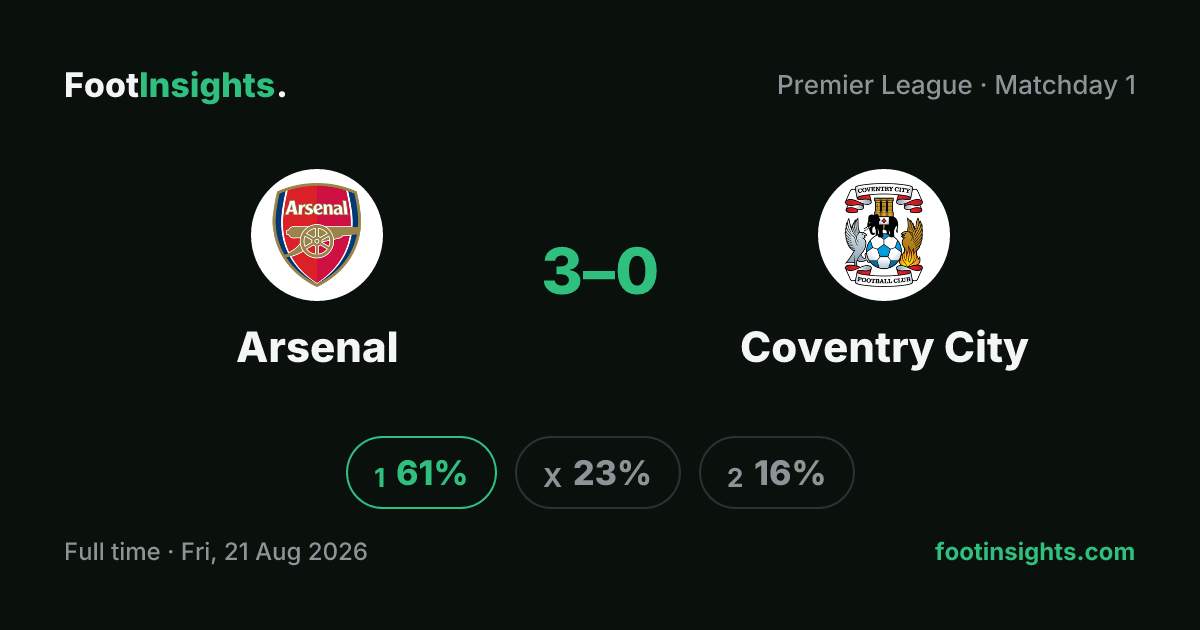
Promoted clubs: what our model knows and when it guesses
Hull arrive from a division we cover; Málaga from one we don't. Why promoted clubs are two different problems for a prediction model, in four fixtures this weekend.
Model watchAtlético 2–0 Málaga: what one result proves about a model–market gap
Our model said 58%, the market said above 70%, and Atlético won 2–0. What one result proves about who was right: almost nothing. Here's what would.
Model watch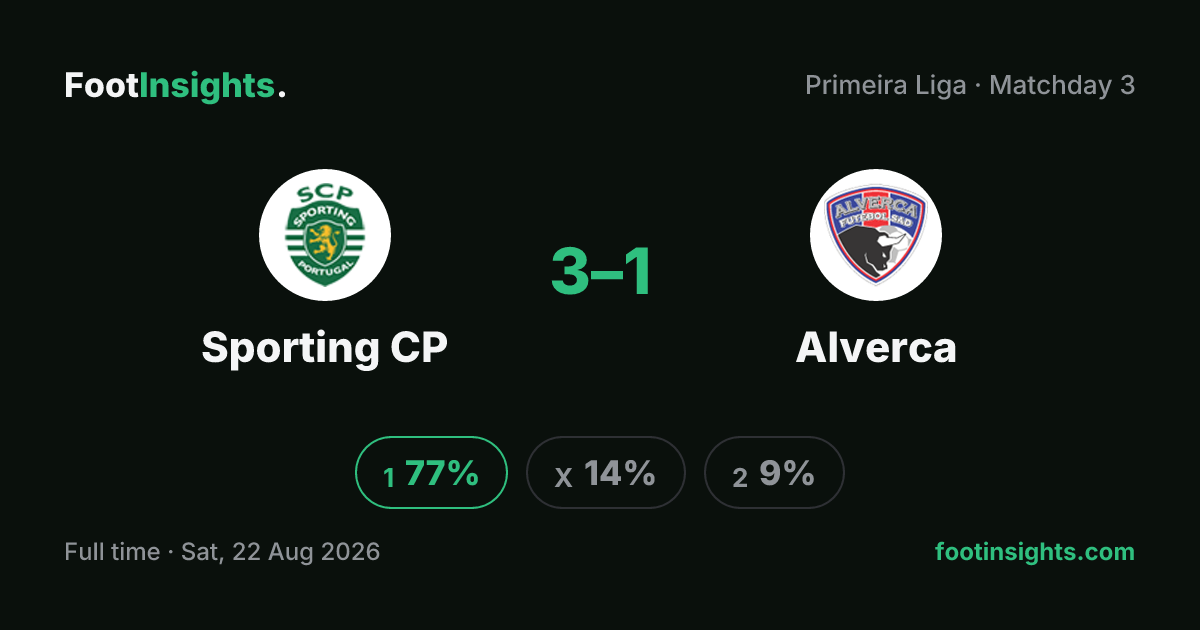
Our model's five strongest calls of the 22–24 August weekend
Five home wins priced at 67% or better across five leagues — and the honest math on why even these probably won't all land.
ModelWhat is expected goals (xG)? The metric, its power and its limits
How xG turns shots into probabilities, what it genuinely fixes, the trap in reading an xG total — and what it adds to a forecast once the odds are known.
ModelHow football prediction algorithms actually work
Ratings, Poisson goals and probabilities — what is really inside a football prediction model, explained without hype by a team that publishes its own results.
ModelThe Poisson distribution in football, explained with real numbers
Why one 19th-century formula still powers most football prediction models — how it works, how well it actually fits 17,495 matches, and where it needs help.